
Fruit that Ripens At the Right Time

Prepare yourselves for worship.
We gather to worship the One
   who binds us all together

Seek to be truly happy.
We strive to avoid evil advice
    and the road of sin.

Listen for God’s instruction.
When we listen we find happiness.

Be like the tree replanted by streams of water.
We trust in God that when we love
    and act justly God’s fruit will ripen
       at just the right time.

license cc

Posted in Call to Worship, Old Testament, Psalm 1, Psalm 1:1-6, Psalms

Does God Cause the Bad to Test Us?

11391360_10206940643177170_3239510362494633209_nEverything happens for a reason…God needed her more than you do…God is testing your faith…God has a plan. Have you heard these before?

***

After snacks, the lights on the plane dimmed and a hush descended. I was left with my emotions. Rather than excitement about going to see family, I felt angst.

Worry and grief gradually superseded the guilt of abandoning my students for a week. Mom was not well.

I was hopeful that I could provide some respite for my father, and especially my sister, who cared for Mom full-time. In a scenario which remains unclear to this day, my mother had a stroke while driving.

She crashed her white Corolla into another car, left the scene, and ran off the side of the highway before being rushed to the hospital. Now that she was home again following the hospitalization, I made my third trip since her initial episode.

It was a challenging year for our family. My mother was ill. My mother-in-law’s health was also failing.

Maggie was in seminary, traveling three-hours each way from our home in upstate New York to Boston for classes and serving a difficult congregation near us.

As for me, I overworked to make the financial pieces of our life fit together while trying to hold the kids as a priority.

As we traveled multiple times to the midwest to care for our mothers — sometimes just one of us, sometimes all of us — the children struggled with the fear of losing their grandmothers and the normal challenges of adolescence and with stressed out parents.

And then it got worse.

***

“Noooooo,” was followed by Isaac’s wild sobs and squeals of pain that will forever pierce me. My cell phone to his ear, Maggie had just told him of her mother’s death.

Everything happens for a reason…God needed her more than you do…God is testing your faith…God has a plan. Have you heard these before?

***

“I can’t go through this again,” our daughter Jessie cried. Sitting on the bed in the Motel 6 debriefing my mother-in-law’s funeral, the topic turned to my mother.

Jessie knew Grandma Graves’ health was precarious at best. She knew that she might lose another grandmother soon.

Everything happens for a reason…God needed her more than you do…God is testing your faith…God has a plan. Have you heard these before?

***

Back home, the phone rang. While we were away at the funeral, Todd killed himself. The young gay man – my daughter’s friend – could no longer bear it. Death was preferable to life. And so, in less than a week was another funeral.

Everything happens for a reason…God needed him more than you do…God is testing your faith…God has a plan. Have you heard these before?

***

The whole family scrambled to find Isaac’s cat. Nope, not upstairs. Nope, not in Dexter’s doghouse where she liked to hang out.

[pause]

It didn’t take very long. We found Trio far too easily; her lifeless body lay in the rural road in front of our house.

Everything happens for a reason…God needed her more than you do…God is testing your faith…God has a plan. Have you heard these before?

***

“Don’t I recognize you?” the smiling rental car clerk said, “Welcome back to St. Louis!” His smile faded when he learned we were back for the third funeral (fourth if you count the cat) in eleven days. My mom had died.

Everything happens for a reason…God needed her more than you do…God is testing your faith…God has a plan. Have you heard these before?

***

What did I do wrong? What did my children and Maggie do wrong?

Our human urge for a pattern to the randomness of life is strong. We want an explanation. Brain researchers even suggest that we have an innate, biological predisposition to find patterns sometimes where none exists.

From a survival of the species vantage point, seeing patterns helps us to avoid making life-threatening mistakes. But sometimes patterns are simply of our own making. Life can be random and inexplicable.

When science fails us in life’s deepest questions, if we believe in a Divine presence, we turn to God for that explanation.

Everything happens for a reason…God needed her more than you do…God is testing your faith…God has a plan. Have you heard these before?

***

If we perceive God as all-powerful, capricious, and unreliable, we may believe that God punishes us for small or large misdeeds. It is easy to fall into this trap.

Some of the early writers of the Elder Testament (the Old Testament) experienced their god in this way. If I believed this, I would be wracking my brain trying to figure out what I did wrong that caused God to kill my mother-in-law, my mother, an 18-year-old boy, and my son’s cat.

That is one harsh image of God!

That is one harsh image of God! Still, it is not a hard perception to find.

Many ancients explained their misfortunes this way. The theology of many of the writers in the Elder Testament reflects a reward and punishment mindset. Even in the twenty-first century there are those who picture a capricious and angry god in natural events.

The prosperity gospel, in which those who please God become wealthy, is the flip side of this theology. I even had a conversation with someone here in town following my surgery. She believed that God was rewarding me with recovery because I’m a pastor.

The troublesome theology of some of our ancient kindred, those without even basic understanding of science, those who didn’t even realize we live on a round planet, is still with us today.

Everything happens for a reason…God needed her more than you do…God is testing your faith…God has a plan. Have you heard these before?

But this is just one theology found in the Elder Testament (the Old Testament). The Book of Job, for example, raises many questions about the nature of God. In the narrative, Job is a good man, righteous in God’s sight. Yet, tragic things happen to him.

His friends admit that he’s done good things  and seemed righteous but they cannot let go of their flawed understanding of God.

Think! [he’s told by his friends,] What innocent person has ever perished?

    When have those who do the right thing been destroyed? As I’ve observed, those who plow sin and sow trouble will harvest it. When God breathes deeply, they perish; by a breath of his nostril they are annihilated. Job 4:7-9 CEB

In other words,

Everything happens for a reason…God needed her more than you do…God is testing your faith…God has a plan. Have you heard these before?

Was God testing me?

How could God allow the trauma of four deaths in eleven days? To explain the challenges of life, many see God as a testing deity. The problem with this explanation is that it characterizes God as a bully and a taskmaster. We are just pawns of a harsh teacher.

United Methodist Pastor Cori Crypet says it this way:

At best, it makes God the author of suffering and the perpetrator of evil. At worst, it makes God out to be a sadist, enjoying the pain and suffering of others, taking pleasure in causing pain. http://coopersvilleumc.org/1/post/2014/02/biblical-mythbusters-myth-1-everything-happens-for-a-reason.html

If we accept this explanation, God tested my then teenage daughter’s worthiness by pushing her friend to kill himself. In this view, my son whose maternal grandmother just died, needed to pass another examination. So, God killed his cat!

Many Christians — many of us in this room — find the metaphor of Father helpful in thinking about God. But a good father doesn’t “test” his children by making their lives a living hell! An actively testing god is intertwined with the idea of an all-powerful deity who chooses not to help God’s people.

This image of divinity is far from loving. This image is contrary to the biblical witness!

In the elder testament, the narrative tells us that despite their repeated evil actions, God honors covenant with the Israelites. In the Book of Judges, God is rightfully angry with God’s people.

The loving God sets hostility aside, honors covenant, and offers undeserved grace because God “could no longer bear to see Israel suffer” (Judges 10: 16b NRSV).

A testing god is an abusive father who contradicts the message of Easter. The Easter narrative emphasizes the same undeserved grace reflected in the the book of Judges and other places in our holy text.

Though we don’t deserve it, the Divine offers all of humanity grace.

In our scripture reading today, the Apostle Paul says,

We know that God works all things together for good for the ones who love God, for those who are called according to his purpose.  Romans 8:28 CEB

Those who begin from the standpoint that everything happens for a reason — not in the Bible by the way — misinterpret this passage and twist it to mean that God is all powerful and God has a plan, and that our free will means little if anything.

But what if, like you and I, God doesn’t know the future. God doesn’t know what we will use our free will to do and to say.

Consider, God knows all the possibilities, all the choices we might make, but until we make that choice…Until we use our God-given free will, God doesn’t know what we will do.

If we are created in the image of God, we have to have free will.

As Robert Mesle says,

God knows everything there is to know. But the future does not exist yet, except as a range of possibilities that have not yet been chosen. (Robert Mesle in Process Theology: An Introduction)

Does this mean that God is an inactive God? Absolutely not!

Allowing us our free will, having created it within us, God seeks to encourage us, to lure us, to point for us to the most loving response in every millisecond of our lives.

God wants us to be more loving. God wants us to care for our neighbor as ourselves. God desires the best for us, the good for us.

Our job is to respond to the divine beckoning and make that choice in every millisecond of our lives.

Writes UCC scholar and pastor Bruce Epperly,

God does not unilaterally cause all things, even good fortune, for persons of faith. In each moment, God has a dream for us and presents us with the energy to achieve it. But, God always acts relationally, receiving as well as giving, responding as well as calling.

Our love of God and others, prayerfully expressed, opens the door for God to bring forth new possibilities of healing and for us to claim our role as God’s partners in healing the earth.

Bruce Epperly in Process Theology: A Guide for the Perplexed

***

Though life is challenging and even traumatic at times, the extravagant love of the One, works through all that happens. The Divine lures us to reflect the Imago Dei (image of God) by responding lovingly in each moment. When we love, we are God in the world.

Less than satisfying to our culturally-ingrained sensibilities, bad things happen to good people. Three human and one feline death in eleven days was a lot for my family to handle a decade and a half ago. I still sometimes weep over my loss.

As the Apostle Paul reminds us, We know that God works all things together for good…Romans 8:28a CEB

God uses all that is — the good and the bad — to bring about God’s loving realm. God doesn’t cause the bad but lures us to dream beyond ourselves, to be the most loving version of ourselves possible.

***

A few weeks back, I found myself spontaneously sobbing. It was my mother’s birthday. I was sad and missed her, yes, but I also felt joy in that moment. I felt God’s presence.

In that moment, I again felt the abundant love of God when friends showed up unexpectedly at my mother’s memorial service. I sat on that curb grieving with my brother again; the loving One perched between us. And I recognized my mother within me: the good and the annoying.

God was present then and now. God is here with us. Does God cause the bad to test us? No.

Instead God beckons us to dream beyond ourselves, to be the most loving version of ourselves possible in every millisecond.

Amen.

license cc

Posted in New Testament, Romans, Romans 8, Romans 8:18-39, Sermon

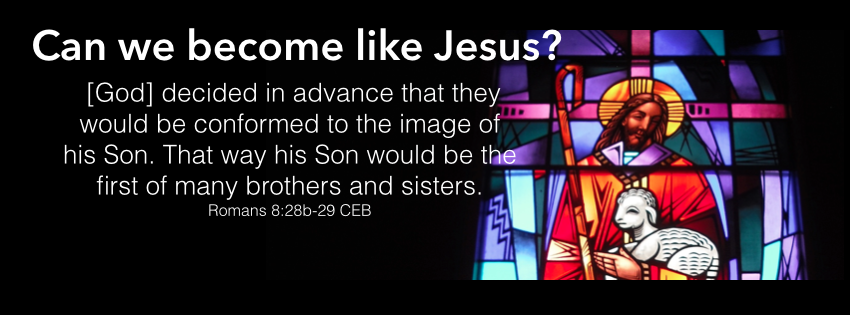
Can We Become Like Jesus?

Screen Shot 2015-06-10 at 8.59.22 AMArriving home after a long day, she took one look around the place and exclaimed, “Why can’t you be more like your brother?!?”

He fed 5000. He called the loathsome out of the tree and ate with them. He challenged injustice in the temple. Why can’t we be more like our brother?!?

[moment of silence]

Writes the Apostle Paul to the church at Rome,

[God] decided in advance that they (that means us) would be conformed to the image of his Son. Romans 8:29b CEB

Paul alludes here to the Genesis of humanity. He makes an implied comparison between being created in the Imago Dei, that is the divine image…

God created humanity in God’s own image, in the divine image God created them, male and female God created them. Genesis 1:27 CEB

Paul makes a comparison between our initial creation in God’s image and our calling to be re-created in the Image of Christ.

Given our human unwillingness (inability?) to live within and toward God’s dream for us, God finds another way. For those of us who call ourselves Christian, God stands upon a new path beckoning us to dream beyond ourselves.

In the person of Jesus, the divine lures and encourages us to become more than we ever thought we could be.

[time of silence]

He fed 5000. He called the loathsome out of the tree and ate with them. He challenged injustice in the temple. Why can’t we be more like our brother?!?

Paul, the ultimate public theologian, is talking about Christology in this section of his letter to the Roman church. Christology has to do with where you place Jesus on the continuum from human to divine.

Historical church doctrine says that Jesus is “fully human AND fully divine.” All the same, even those who claim to accept this doctrine tend to favor one or the other.

That is, we tend to think of Jesus more in divine terms or more in human terms.

I tend to favor a low Christology. That means that I find the humanity of Jesus most helpful in my personal understanding of God’s call in my life. He’s one of us, works for me.

Some of you, may favor a high Christology. That means you relate to the divinity of Christ more than the humanity of Christ. If this is you, thinking of Jesus in this way helps you with your day to day faith.

Generally speaking, those of us who are UCC have a lower Christology than those in the Catholic or Greek Orthodox churches. It’s not always true but mostly true.

And, of course, none of us are always consistent in our thinking. It’s not like you woke up one morning and decided, “This is what I’m going to believe.”

It is our upbringing, our experiences, and the Holy Spirit who lead us to our particular way of understanding who Jesus was and is for us.

As a rule, neither high or low christology is right to the exclusion of the other. They both can be legitimate ways of understanding Jesus.

[time of silence]

He fed 5000. He called the loathsome out of the tree and ate with them. He challenged injustice in the temple. Why can’t we be more like our brother?!?

In the letter to the Romans, Paul tells the Jews and Gentiles of that mid-first century church that we are called to “conform” to Jesus. Paul tells them that God,

decided in advance that they would be conformed to the image of his Son. That way [God’s] Son would be the first of many brothers and sisters. Romans 8:29b CEB

To conform to the image of Jesus is to become like Jesus not to be Jesus. In other words, not only can we become like Jesus, we are expected to work at becoming like Jesus.

[time of silence]

He fed 5000. He called the loathsome out of the tree and ate with them. He challenged injustice in the temple. Why can’t we be more like our brother?!?

In talking with someone, I once raised the question that serves as sermon title today.

“Never!” she said, “I can never be like Jesus. He was perfect; I can never be perfect!”

Though neither high or low christology is inherently bad, in this case, the woman’s exceedingly high christology made it difficult for her to heed God’s claim on her life.

She perceived Jesus as far removed from humanity. In her way of thinking, Jesus is God.

It was arrogant and presumptuous, in her mind,  for me to even ask if she could become like Jesus. But it is not just me asking the question.

It is Paul telling the Roman church — and us — that we are to strive in our every action to become like Jesus.

This is a caution for us to be aware of our understanding of Jesus so that it does not prevent us from learning and growing in our faith. An overly high christology can prevent us from being Christ’s body on earth.

In the words of Teresa of Avila,

Christ has no body but yours,

No hands, no feet on earth but yours,

Yours are the eyes with which he looks

Compassion on this world,

Yours are the feet with which he walks to do good,

Yours are the hands, with which he blesses all the world. (excerpt from Christ Has No Body by Teresa of Avila)

[time of silence]

He fed 5000. He called the loathsome out of the tree and ate with them. He challenged injustice in the temple. Why can’t we be more like our brother?!?

If we embrace too high a christology then to become like Jesus is utterly unattainable. Why should we bother to even attempt to be Christ’s hands with which he blesses the world? Why should we even try to emulate Jesus if it’s impossible?

With too high a christology  — too much emphasis on Christ’s divinity — we just settle for human kindness, for showing up at church once a quarter, and doing the minimum. Too high a christology can lead to abdicating our responsibility as followers of our brother Jesus.

Too high a christology can lead to abdicating our responsibility as followers of our brother Jesus.

[time of silence]

He fed 5000. He called the loathsome out of the tree and ate with them. He challenged injustice in the temple. Why can’t we be more like our brother?!?

True enough, we’re not perfect but if we start with our imperfections instead of our goal — the goal God sets before us — then we’ll never reach our potential in being like Jesus. We will deny the image of God in which we are created.

And when we deny the image of God in ourselves, we’re rejecting God’s dream  not only for ourselves but for one another.

Hear the words of Paul again:

[God] decided that they would be conformed to the image of his Son. That way [God’s] Son would be the first of many brothers and sisters. Romans 8:29b CEB

We are siblings with Jesus, according to Paul. Jesus is our older brother to whom we should all look up. Jesus is the first among many brothers and sisters — us.

Jesus is the brother who, despite his humanity, breathes in the divine one and breathes out extravagant love. Our job is to strive to become like him.

Amen.

[time of silence]

Posted in Genesis, Genesis 1, Genesis 1-2, Genesis 1:26-27, New Testament, Old Testament, Romans, Romans 8, Romans 8:18-39, Romans 8:29b, Sermon

Squinting in the Mirror: A Prayer of Confession & Hope

Creator of the immensity & mystery:

You created us in your image,
   squinting, we see you in the mirror.

But we left your dream,
   pursuing our own selfish,
      idol-filled fantasies.

You could not bear to see us suffer,
   & you opened your covenantal arms.

We left and you called.
We returned and you embraced.
Still, we pursued idol-filled ways.

We confess again. We ask forgiveness.

And through our brother Jesus,
   your image in which we are created,
     is fresh again!

Our eyes turn again to that mirror,
   squinting, we see you.

Turning toward our earthly neighbors,
   we glimpse the same image of you.

Encourage us, lure us, tempt us to
   fulfill your dream of expansive love
      for the immensity & mystery.

Amen.                                               

based on Genesis 1:26-27, Judges 10:16, & Romans 8:29

license cc

Posted in Confession of Sin & Assurance, Genesis, Genesis 1, Genesis 1:26-27, Judges, Judges 10, Judges 10:16, Prayer of the Day, Romans, Romans 8, Romans 8:18-39, Romans 8:29b

Every Time I Feel the Spirit Moving

11351387_10206888036862045_103796870199822216_nLooking back at it all, I can see the broad movements of the Holy Spirit in my life, beckoning me forward. At the time, I wasn’t always sure; often I was confused, or full of angst, or desirous of another path.

And I now find myself praying a prayer of humble gratitude for all that has transpired.

Every time I feel the Spirit moving in my life I will pray.

***

As a matter of traditional church doctrine, to be Christian is to believe in the trinity: the Father, the Son, and the Holy Spirit. Nonetheless, the truth is that there are non-trinitarian Christians. There are non-trinitarian UCCers.

For me, I find the language of the trinity useful in thinking about God but I don’t believe it — or any other theological construct — can accurately and fully describe the divine mystery that we call God.

In other words, the way we think of the trinity is at best an approximation of the nature of God.

[pause]

Despite what it says in the header of your bulletins, today really isn’t Pentecost. Pentecost was last week but, well, we had 4oh!4. Today is Trinity Sunday. I know so because it says so in my official UCC calendar.

Just the same, for us it is also Pentecost. Pentecost is such a foundational day in the church that we couldn’t just skip it. We could move it, we are Congregationalists after all, but we couldn’t ignore it completely.

Well, I couldn’t ignore it, anyway.

***

She was laughing and smiling. It was a good day. The sunshine. The shades of yellow and orange sprouting as spring flowers. All of this and more buoyed her sense of well-being.

A moment later, she was in a full throttle sob as she released all the pain of her journey thus far.

Every time I feel the Spirit moving in my life I will pray.

***

So what do we know about the Holy Spirit? What do we know about the Spirit, the most neglected part of the doctrine of the trinity?

God the parent, the father is the creator. Jesus is the son, the redeemer or savior. But who or what is the Holy Spirit? It is as if even the definition of the Spirit is a mystery or secret. William Paul Young, in his fictitious work The Shack described the Holy Spirit this way:

“As she [the Holy Spirit] stepped back, Mack found himself involuntarily squinting in her direction, as if doing so would allow his eyes to see her better.

But strangely, he still had a difficult time focusing on her; she seemed almost to shimmer in the light and her hair blew in all directions even though there was hardly a breeze.

It was almost easier to see her out of the corner of his eye than it was to look at her directly.” (The Shack, pg.84)

It was almost easier to see her out of the corner of his eye than it was to look at her directly.” (The Shack, pg.84)

Wow, that part rings true to my experience. The Spirit is always around — but a little hard to perceive — just as Jesus promised and implied in the fourteenth chapter of John:

“I will ask the Father, and he will send another Companion,[a] who will be with you forever. 17

This Companion is the Spirit of Truth, whom the world can’t receive because it neither sees him nor recognizes him. You know him, because he lives with you and will be with you. John 14:16-17 CEB

Likewise, Luke promises in his gospel that the Spirit will be present with us. Then, in his sequel Acts, the promise becomes reality. Despite this, we have a far less developed sense of who the Spirit is than our Pentecostal, orthodox, and even our Catholic sisters and brothers.

Who is the Holy Spirit? Scholar Gordon Fee, says that “In dealing with the Spirit, we are dealing with none other than the personal presence of God.” (Paul, the Spirit, and the People of God, loc. #631)

Think about that a moment. If, as the doctrine of the trinity implies, the Father, Son, and Spirit are equally and fully the one God then of course that would be true. It also has the effect that we ought to be a little more alert to that presence and voice in our lives.

***

They looked at one another. How could their plans be coming together this way? It seemed, if not too easy, at least too obvious a path that was unfolding before them. Once they’d stopped fighting for their own visions, a vision that made sense had miraculously appeared.

Every time I feel the Spirit moving in my life I will pray.

***

So what can we learn about the Holy Spirit from our scripture readings today? That is, what can we learn from our ancient kindred who wrote the Acts of the Apostles and the letter to the Romans?

Let’s start with Acts.

In verse four, “All of them were filled with the Holy Spirit…” The result was that they could all speak in the languages of one another.

The sense of the word translated from the greek as filled has to do with being supplied or equipped by the Spirit. The Holy Spirit gifts people in such a way that they might be in relationship with one another.

The Father/Mother created. Jesus taught and pointed a way out of sin. And the Spirit equips and sustains us in our journeys.

***

When Pentecost Day arrived, they were all together in one place. They saw what seemed to be individual flames of fire alighting on each one of them. 4 They were all filled with the Holy Spirit and began to speak in other languages as the Spirit enabled them to speak. Act 2:1, 3-4 CEB

Every time I feel the Spirit moving in my life, I will pray.

Now, What does the Apostle Paul in his letter to Romans tell us about his understanding of the Holy Spirit?

In verse twenty-six of our reading, “the Spirit helps us in our weakness” and “intercedes for us with sighs too deep for words” (Romans 8:26 NRSV)

I love this verse! It really takes the load off for me. We don’t have to get it right. Part of God helps us communicate — pray — to another part of God.

Our God really is an awesome God!!

In his accumulated letters, the epistles, the Apostle Paul does more than simply suggest that the Holy Spirit helps us and intercedes on our behalf.

Paul believed that a Christian life is integrated with the Holy Spirit. That is, to live a life as a follower of Jesus, we must also listen for, listen to, and follow the Holy Spirit’s beckoning. The Holy Spirit, according to Paul, must be embedded in our very lives.

Writing about the early church, scholar Gordon Fee says,

But their success…lay with their experienced life of the Spirit who made the work of Christ an effective reality in their lives, thus making them a radical alternative within their culture. (Paul, the Spirit, and the People of God, loc. #xxx)

***

She trusted her child and the Holy Spirit to work out their own relationship. Though she talked about spirituality, she allowed space for her six-year-old to think it through herself.

One day, the child said to her mother, “I don’t believe in God.”

Instead of panicking, the young mother nodded her head and said, “hmmm.” The child continued, “But I believe in the parts that I think are true. And our hearts are actually God.”

Every time I feel the Spirit moving in my life I will pray.

***

I think Paul would be appalled at the lip service that the mainline church gives to the Holy Spirit. I think Paul would be writing us one of his terse, “get your act together epistles.”

Imagine if you will an excerpt from Paul’s Epistle to the American Mainline Church:

“My friends, your steadfast endurance has been a blessing to your communities across your nation. I had hoped to visit each of you but so far have been unable.

I remember each of your churches in my daily prayers. Your commitment to social justice work in the United Church of Christ, for example, has been and continues to be a witness to others. I urge you to continue this.”

“It is clear to me that your well-thought out theologies have helped you to reach a place where you’ve made a connection between the teachings of Jesus and the actions you take in the world.”

“As admirable as your commitment to thinking and reasoning are in helping you to understand Christ’s redemptive powers in the world, you must diligently guard against turning thinking and reasoning into idols.”

“Many of you have failed at this already. Your worship has become hollow lacking in passion or joy. Friends, I cannot state this too strongly: you cannot think your way to God.”

There are many beyond your cavernous buildings who yearn for and need the Good News. Turn your hearts, your whole beings toward the shimmering one promised and delivered to your predecessors in the faith. Turn toward the  Holy Spirit, the sustainer of your faith.”

“Did not your Savior himself pray regularly? Did he not even pray for others as he suffered upon the cross? Did even the Christ need guidance from the Father and the Spirit at times?”

“So why has the Holy Spirit become something only your more Pentecostal kindred embrace? Why are you so afraid of getting out of our heads? I implore you embrace the Father, the Son, AND the Holy Spirit who remains with you as our Lord and Savior promised.”

“When you do, you will glimpse the advocate, the companion beckoning you to become the community of faith needed in your time. Embrace the presence of the one among three! She is with you already; you’ve only to perceive and follow.”

Every time I feel the Spirit moving in my life I will pray.

___

Rev. Tim Graves preached this sermon at the Condon United Church of Christ, Condon, Oregon on May 31, 2015.

license cc

Posted in Acts, Acts 2, Acts 2:1-4, Days of the Church, New Testament, Pentecost, Romans, Romans 8, Romans 8:18-39, Sermon, Trinity Sunday

Out of the World

Out of the Delights,
out of the joyous times,
we gather together.

Out of the Tedium,
the long days that drag,
we gather together.

Out of the Depths,
out of the difficult times,
we gather together.

We gather to worship the One who works to bring good out of whatever happens.
Praise be to God!
Let us worship! Amen.

Posted in Call to Worship, Romans, Romans 8, Romans 8:18-39, Uncategorized

Beacons of Love, Hope, & Justice

   The abundant One calls to us,
“Gather as one, beloved people.”

   We gather as people beloved!

   The Creator, the Teacher, & the
      Mystery reminds,
“I am with you always.”

   We come to worship the
      God of hope, love, and grace.

The God of resurrections,
   yearns to transform us into
beacons of love, hope, & justice.

We are here to become beacons.

  May we live as people transformed
      & resurrected!
May we be God’s own hopes.

 In this hour, may we become who
      God dreams we can be. Amen.

Posted in Call to Worship, Romans, Romans 6, Romans 6:1-14

Living Within Grace

Confessing Sins

Holy One,

   In your presence & the presence
       of our Christian community,
          we lay our sins before you.

   We live as if the resurrection,
       never happened.

    We live as if your grace is a
       “Get Out of Jail Free” card,
            & fail to live fully within
                 your grace.

     Forgive us for failing to offer,
       our bodies, minds, & hearts,
          as instruments of your grace.

   Contritely & humbly,
        we recommit ourselves to you.
   Amen.

Receiving Assurance

   Look around you.
       Look in each face.

   Look at the wheat as it germinates
       and bursts forth from the earth.

   Look at the sage that heals hearts
       and cleanses spirits.

    Look inside,
        seeing the divinity within you.

   Look at the blue sky &
each creature and person.

   Grace abounds!
   Grace belongs to you!

You are forgiven!

license cc

Tagged with: , , ,
Posted in Confession of Sin & Assurance, Romans, Romans 6, Romans 6:1-14

Generosity

In the kingdom of God we find that generosity of spirit, generosity of possessions, & the radical sharing of skills are practiced openly.

As the offering plate comes round, place your hand over it. Commit to God that you will use all your gifts and skills — your whole being — for furthering the extravagance of the God’s unfolding realm.

license cc

Tagged with:
Posted in Matthew, Matthew 20, Matthew 20:1-16, New Testament, Offering

Veni Sancte Spiritus

Almighty God,
  We call upon you in this hour.
Veni Sancte Spiritus.

We seek your presence.
Veni Sancte Spiritus.

Come Holy Spirit.
Veni Sancte Spiritus.

Touch our essence, reveal yourself.
Veni Sancte Spiritus.

Lure us, guide us, mold us.
Veni Sancte Spiritus.

Through Jesus the Christ,
we call out to you.
Veni Sancte Spiritus. Amen.  

license cc

Tagged with: , ,
Posted in Call to Worship, Invocation
Creative Commons License BY-NC-ND 3.0 https://creativecommons.org/licenses/by-nc-nd/3.0/us/

All materials by Tim Graves unless otherwise noted. Creative Commons License BY-NC-ND 3.0 https://creativecommons.org/licenses/by-nc-nd/3.0/us/

Category Search.